Why People Remember Restaurants That Engage All 5 Senses
Think about the last restaurant you truly loved.
Was it only because the food tasted good?
Probably not.
Maybe you remember the smell when you walked through the door.
Maybe there was a beautiful warm light.
Maybe the music was just right.
Maybe you remember the sound of sizzling food arriving at your table.
Maybe the staff made you feel welcome.
Maybe the food looked so good that you immediately took out your phone to take a picture.
And then there was the taste.
That's what makes a restaurant memorable.
A great restaurant doesn't simply feed people.
It creates a feeling.
Your Customer Doesn't Walk Into a Restaurant With Just a Stomach
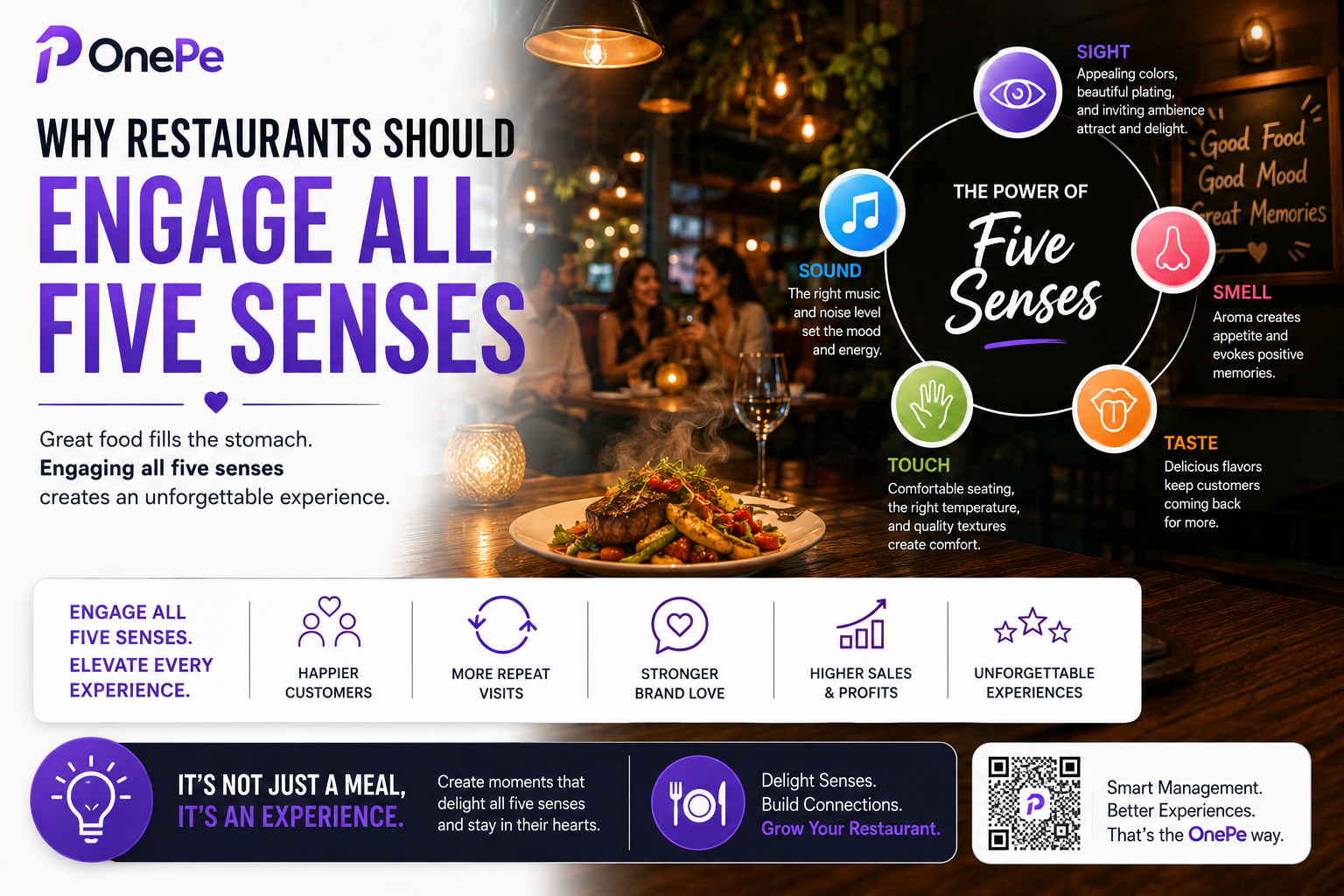
They walk in with five senses.
They see.
They hear.
They smell.
They touch.
They taste.
And all of these senses are constantly sending signals to the brain.
That's why two restaurants can serve equally good food, yet one becomes someone's favourite while the other is quickly forgotten.
The difference can be the experience surrounding the food.
1. Taste: The Sense That Brings Customers Back
Let's start with the obvious one.
Taste.
No amount of beautiful interiors, music or marketing can save a restaurant with consistently poor food.
Taste is the foundation.
Customers remember:
- The flavour
- The freshness
- The texture
- The temperature
- The balance of spices
- The quality of ingredients
- The consistency
But there's an interesting thing about taste.
A customer might forget exactly what they ate.
They may not remember every ingredient.
But they'll remember:
"That place had amazing food."
That's what restaurants should aim for.
Not just a good first bite.
A taste customers want to experience again.
2. Smell: The Restaurant's Invisible Advertisement
Imagine walking past a restaurant.
You suddenly smell freshly baked bread.
Or grilled kebabs.
Or butter, garlic and spices coming from the kitchen.
You weren't planning to eat.
But suddenly...
You're hungry.
That's the power of aroma.
Our sense of smell can strongly influence how we perceive food and our environment.
For restaurants, aroma is therefore part of the experience.
The smell of freshly prepared food can communicate:
Freshness. Quality. Warmth. Appetite.
A restaurant should never underestimate the power of what customers smell before they even take their first bite.
3. Sound: The Music You Feel Without Noticing
Have you ever entered a restaurant where the music was so loud that you couldn't have a conversation?
Or a restaurant where the music was so quiet that the room felt uncomfortable?
Music changes the personality of a space.
The right soundtrack can make a restaurant feel:
- Energetic
- Romantic
- Relaxed
- Premium
- Modern
- Traditional
- Fun
The important thing isn't simply playing music.
It's choosing music that matches the restaurant's identity.
A family restaurant doesn't necessarily need the same atmosphere as a premium lounge.
A café doesn't need the same soundscape as a fine-dining restaurant.
Your music should tell the same story as your food.
4. Sight: Customers Eat With Their Eyes First
Before customers taste your food...
They see it.
And this is where presentation becomes incredibly important.
Think about a beautifully plated dish.
The colours.
The arrangement.
The garnish.
The plate.
The lighting.
The presentation.
Before the customer takes a bite, their brain has already formed an expectation.
That's why restaurants should pay attention not only to how food tastes but also to how it looks.
And today, there's another reason.
Customers photograph food.
A visually beautiful dish can become free social media marketing.
One customer takes a photograph.
Posts it.
Friends see it.
Someone asks:
"Where is this?"
And suddenly your customer has become your marketer.
5. Touch: The Sense Restaurants Often Forget
Touch isn't just about touching food.
It's about everything the customer physically experiences.
Think about:
- Comfortable chairs
- The texture of the table
- Cutlery
- Glassware
- Napkins
- Menu cards
- Packaging
- Door handles
- Temperature of the room
Even the weight and feel of a menu or glass can influence how a place feels.
A premium restaurant usually doesn't feel premium because of one thing.
It's the combination of hundreds of tiny details.
And Then Something Magical Happens
When all five senses work together...
The restaurant becomes an experience.
Imagine this:
You enter.
You see warm lighting and beautiful interiors.
You hear calm music.
You smell freshly prepared food.
You sit in a comfortable chair.
You see a beautifully presented dish arrive.
You take the first bite.
The taste confirms everything your other senses promised.
That's not just dinner.
That's a memory.
People Don't Always Return for Food
This is one of the biggest lessons restaurant owners should understand.
Customers may return because of the food.
But they can also return because of the feeling they associate with the restaurant.
Think about your favourite restaurant.
You might say:
"The food is amazing."
But if someone asks you why you really like going there, you might mention:
"The atmosphere is great."
"The staff are really nice."
"I love the music there."
"It's peaceful."
"It's perfect for dates."
"I love sitting there with my friends."
That's the difference between selling food and creating an experience.
The Restaurant Is More Than the Kitchen
Restaurant owners naturally focus on:
Food → Cost → Menu → Orders → Revenue
But customers experience something much bigger:
Food + Smell + Sound + Visuals + Comfort + Service + Emotion
That's why restaurant success isn't only about having a great chef.
It's about creating an environment where customers want to stay, share and return.
The Instagram Test
Here's a simple test for restaurant owners.
Ask yourself:
If a customer takes a photo inside my restaurant, does it look worth sharing?
If the answer is yes, you're doing something right.
Your:
- Food
- Interior
- Lighting
- Table setup
- Packaging
- Signage
- Presentation
can all become part of your marketing.
In today's social-media-driven world, shareability is a restaurant asset.
Create a "Signature Experience"
Every successful restaurant should have something people associate with it.
It could be:
🍽️ A signature dish
🎵 A signature music style
🌿 A signature aroma
💡 A signature interior
🥤 A signature drink
📦 A memorable packaging design
📸 A photogenic presentation
😊 A unique service ritual
The goal is to make customers say:
"This is so [restaurant name]."
That's branding.
Technology Should Support the Experience — Not Replace It
Technology is becoming an important part of modern restaurants.
Digital menus.
QR ordering.
Online payments.
Reservations.
Loyalty programs.
Customer communication.
But technology shouldn't make the restaurant feel cold.
Instead, it should remove friction so the restaurant can focus on what technology cannot replace:
Hospitality.
A QR code can make ordering easier.
A digital menu can make browsing faster.
A loyalty system can encourage customers to return.
But the aroma of freshly cooked food?
The music?
The smile from the staff?
The atmosphere?
That's the restaurant.
Where OnePe Fits In
A restaurant's physical experience and digital experience should work together.
That's where OnePe can help restaurants build the digital side of the customer journey.
For example:
Customer enters restaurant
↓
Scans QR code
↓
Views digital menu
↓
Places order
↓
Enjoys the experience
↓
Earns loyalty rewards
↓
Receives offers
↓
Returns again
The physical experience creates the emotion.
The digital experience helps the restaurant continue the relationship.
The Restaurant of the Future Will Sell Experiences
Food will always be important.
But restaurants are increasingly competing on more than food.
They are competing on:
Experience.
A customer has countless choices today.
They can order from home.
They can try another restaurant.
They can visit a café.
They can cook at home.
So why should they choose your restaurant?
The answer shouldn't only be:
"Because our food is good."
It should be:
"Because you feel good when you're here."
A Simple Exercise for Restaurant Owners
Walk into your restaurant as if you were a customer.
Don't think like the owner.
Think like a first-time visitor.
Ask yourself:
👀 What do I see?
Is it attractive?
👂 What do I hear?
Is the music appropriate?
👃 What do I smell?
Does the environment smell fresh and inviting?
✋ What do I feel?
Are the furniture, tables and environment comfortable?
👅 What do I taste?
Is the food memorable?
Then ask the most important question:
❤️ What do I feel?
Because that's ultimately what customers remember.
Great Restaurants Don't Just Serve Food
They create anticipation before the first bite.
They create comfort while customers eat.
They create memories after customers leave.
And they create reasons for customers to come back.
Taste gets the customer excited.
Aroma gets their appetite going.
Music sets the mood.
Visuals create desire.
Comfort keeps them engaged.
Hospitality creates emotion.
And when all of these come together...
You don't just have a restaurant.
You have an experience people want to remember.
And when customers remember the experience, they're far more likely to talk about it, share it and come back.
Because the best restaurants don't just feed people.
They make people feel something.